
- What kind of linguistic and visual strategies have been used in social media memes during the Indo-Pak 2025 conflict to highlight "us" positively and "them" negatively?
- In what ways did images, captions, symbols and cultural references strengthen or challenge Hyper-nationalist ideologies in Indo-Pak social media memes during Indo-Pak conflict 2025?
Abstract
This study critically investigates hyper-nationalism in Indo-Pak social media memes shared during the 2025 Indo-Pak conflict using Multimodal Critical Discourse Analysis (MCDA). It examines how memes construct hyper-nationalist narratives, national identity, and representations of the rival nation through visual, textual, and symbolic elements. The study adopts a qualitative, interdisciplinary approach and analyzes a purposive sample of 14 memes (07 Indian and 07 Pakistani) collected from Instagram, Facebook, and X (Twitter). The theoretical framework is based on Benedict Anderson's Imagined Communities (2006) and Teun A. van Dijk's Ideological Square (1998). The findings reveal that memes from both countries promoted national superiority, glorified military strength, mocked the opposing nation, and mobilized public sentiment. Visual imagery, captions, and cultural symbols reinforced hyper-nationalist discourse. The study concludes that social media memes have become influential tools for constructing and disseminating hyper-nationalism in contemporary digital culture.
Keywords: Indo-Pak Conflict, Social Media, Memes, Ideological Square, Imagined Communities, Benedict Anderson, Teun A. Van Dijk
Introduction
Pakistan and India are nuclear power neighbouring countries of South Asia. Since 1947, their conflict, based on Kashmir, is known as the one of longest-running disputes of South Asia. After getting independence from British rule, India and Pakistan have fought four major wars (Schofield, 2010). Despite all these wars, the conflict between India and Pakistan rose again in May 2025.
Pakistan-India conflict 2025 was an important turning point in South Asian geopolitics, which began on April 22 with an attack in the Baisaran Valley of Pahalgam, Indian Occupied Kashmir, and intensified through India's "Operation Sindoor" and Pakistan's "Bunyan Al Marsoos" counterattack (Ghilzai, 2025). The Indo-Pak conflict of 2025 was distinct in that it seemed to be a meme war too as social media platforms were quite involved. Social media acted as a primary source of information, propaganda, and false information during the 2025 India-Pakistan crisis. However, the results show that the social media users from both nations used digital platforms to spread their ideology-driven ideas, emotional appeal, and formed enemy images, which further heightened tensions (Bashir & Shahid, 2025).
Social media platforms have transformed communication in the twenty-first century by using satire and humor to convey thoughts and information. In the digital age, memes have become an important communication tool, particularly on social media sites like Facebook, Instagram, and X (Twitter). The word "meme" originates from the ancient Greek word "Mimema" that means "something imitated" or "an imitation." Richard Dawkins initially described it in his 1976 book The Selfish Gene. He explained that "Examples of memes are tunes, ideas, catch-phrases, clothes fashions, and ways of making pots or of building arches. Just as genes propagate themselves in the gene pool by leaping from body to body via sperm or eggs, so memes propagate themselves in the meme pool by leaping from brain to brain via a process which, in the broad sense, can be called imitation" (Dawkins, 1976, p. 192).
Memes emerged as a technique used by the Indian and Pakistani nations to analyze, assess, and reframe the conflict in 2025. The primary emphasis of this study is to examine how these memes express and disseminate hyper-nationalism in Indo-Pak social media memes during the Indo-Pak conflict 2025. Hyper-nationalism may be seen as an extreme expression of nationalism in which the concept that one nation, ethic or social group, or a particular racial identity within the nation, is superior. This mentality is frequently closely linked to xenophobic and exclusionary viewpoints, which establish barrier that separate the nation's in-group from those viewed as outsiders (Khan, 2016). The present study examines hyper-nationalism in Indian and Pakistani memes which were shared during the Indo-Pak conflict 2025 through qualitative approach. This study uses Multimodal Critical Discourse Analysis, along with Anderson's (2006) Imagined Communities and Van Dijk's (1998) Ideological Square, to examine how Pakistani and Indian memes built hyper-nationalism and created a strong sense of national identity and thus divided groups into "us" and "them" during the Indo-Pak conflict 2025. This research aims to give answers to the following questions:
Literature Review
Several scholars have examined articles, news editorials, media outlets, memes, interviews, and speeches regarding the 2025 conflict between Pakistan and India using various frameworks.
Maryam, Ullah, and Ashraf (2025) conducted a comparative critical discourse analysis of official military press conferences held by India and Pakistan during the 2025 war, applying Fairclough's Three-Dimensional Model, van Dijk's Ideological Square, and Entman's Framing Theory. Their findings showed that India's Ministry of Defence used a technocratic and legal tone, while Pakistan's Inter-Services Public Relations used religious symbolism and emotional language tied to sacrifice (Maryam, Ullah & Ashraf, 2025).
Arshad, Mehmood, and Ahmad (2025) explored educational memes shared during the Indo-Pak war 2025, focusing on their use within the field of education. The researchers collected data from social media platforms including YouTube, Facebook, Instagram, and TikTok, and analyzed the material through a content analysis approach. The findings show that memes are effective tool for sharing public opinion, knowledge and linkage the education to the real world (Arshad, Mehmood & Ahmed, 2025).
Feyyaz and Bari (2024) examined how India and Pakistan verbalize terrorism discourse within a comparative framework rooted in colonialism and geopolitics. The study argues that this discourse enables exclusionary politics, doublespeak, and propaganda, while nurturing self-fulfilling ideas of statehood based on a constructed reality (Feyyaz & Bari, 2024).
Jan, Latif, and Ali (2023) conducted a comparative analysis of peace and conflict journalism in newspaper blogs covering Pakistan-India relations between 2019 and 2020, a period marked by tension following the Pulwama attack. Using a content analysis approach, the study found that bloggers largely practiced war journalism rather than peace journalism, and emphasizes the role of blogs in shaping public opinion (Jan, Latif & Ali, 2023).
Prior researches have examined social media memes and newspapers related to the Indo-Pak conflict separately, but no study has contrasted the memes from the two nations by using two interdisciplinary approaches -Benedict Anderson's Imagined Communities (2006) and Van Dijk's Ideological Square (1998) and examined how hyper-nationalism spread through memes during the 2025 conflict. This is a significant research gap and this study aims to fulfill this gap by applying two interdisciplinary approaches.
Methodology
The hyper-nationalism in Indian and Pakistani social media memes during the Pakistan-India conflict of 2025 (April-May) has been examined in this study through the qualitative research method with an interpretive approach. The main analytical tool for examining the data is Multimodal Critical Discourse Analysis (MCDA). This research is based on interdisciplinary approaches that combine both Benedict Anderson's (2006) Imagined Communities and Teun A. Van Dijk's (1998) Ideological Square.
The data utilized in this study came from social media platforms where memes were widely shared during the Indo-Pak conflict 2025. Memes were purposefully chosen from popular social media platforms like Facebook, Instagram, and X (Twitter), from the period 24th April, 2025 to 24th May, 2025. The data collection was focused on memes that openly or implicitly featured themes of hyper-nationalism, national identity and "Us versus Them" narratives.
The present study adopted a purposive sampling technique to select data relevant to the research objectives. According to Adolph Jenson, "A purposive selection denotes the method of selecting a number of groups of units in such a way that selected groups together yield as nearly as possible the same average or proportion as the totality with respect of those characteristics which are already a matter of statistical knowledge" (Rai & Thapa, 2015, p. 5). A total of 14 social media memes were selected for analysis, including 7 memes from Pakistani accounts and 7 from Indian accounts.
Theoretical Framework
The study uses Multimodal Critical Discourse Analysis as the main analytical approach to obtain a deeper understanding of how hyper-nationalism is generated in memes.
Multimodal Critical Discourse Analysis, which was developed by Kress and Van Leeuwen (2001), has been used to identify both visual and textual elements in memes. According to Kress and Van Leeuwen (2001), multimodality refers to communicative occurrences in which several semiotic modalities are coordinated into a cohesive whole. In a particular social environment, these modalities interact and weave together to create meaning (Kress & Van Leeuwen, 2001). Thus, MCDA studies how semiotic resources are selected and structured to build meaning and position viewers or readers in particular ways.
The present study is grounded in two interdisciplinary theoretical approaches that integrate Teun A. Van Dijk's (1998) Ideological Square and Benedict Anderson's (2006) Imagined Communities. These theories provide a theoretical framework for studying hyper-nationalist narratives in social media memes.
One of the most significant works in the field of nationalism studies is Benedict Anderson's Imagined Communities (2006). In this work, Anderson conceptualizes the nation as a socially constructed community that exists through shared imagination rather than direct interpersonal interaction. According to Anderson (2006), the nation is defined as "an imagined political community and imagined as both intrinsically limited and sovereign" (p. 6).
Anderson's analysis of the nature of "print capitalism" and its importance for the historical development of national consciousness is one of his primary methodological findings. People could read the same stories at the same time because of the broad distribution of newspapers and other print media, which fostered a shared national imagination (Anderson, 2006). This argument provides a clear justification for the present study's concentration on media texts. In short, Anderson's (2006) Imagined Communities gives a satisfactory methodological base for examining nationalism as a discursive and representational as well as a political phenomenon. This theoretical framework serves as a foundation for the analysis of the media discourse, which is crucial for directing the methodological approach in any research.
The Ideological Square of Van Dijk (1998) is another theoretical method used to analyze social media memes. By contrasting the selected memes in the binary opposition of "Us" vs "Them," this framework builds a methodical model for comprehending how language causes ideological polarization amongst social groups. According to Van Dijk (1998), ideological discourse typically concentrates on the positive traits, values, and conduct of the in-group and the negative traits of the out-group, which he referred to as "Our good things" and "Their bad things". Van Dijk's (1998) Ideological Square, which emphasizes hyper-nationalistic ideology through positive self-presentation and negative other-presentation, offers a strong and methodical framework for analysing how social media memes create in-group and out-group representations.
Comparative Analysis of Indo-Pak Social Media Memes
The comparative analysis of Indian and Pakistani memes mainly focuses on the semiotic resources to identify patterns and themes of hyper-nationalism, interpreted through Anderson's (2006) Imagined Communities and Van Dijk's (1998) Ideological Square.
Indo-Pak Memes 01: Comparative Analysis
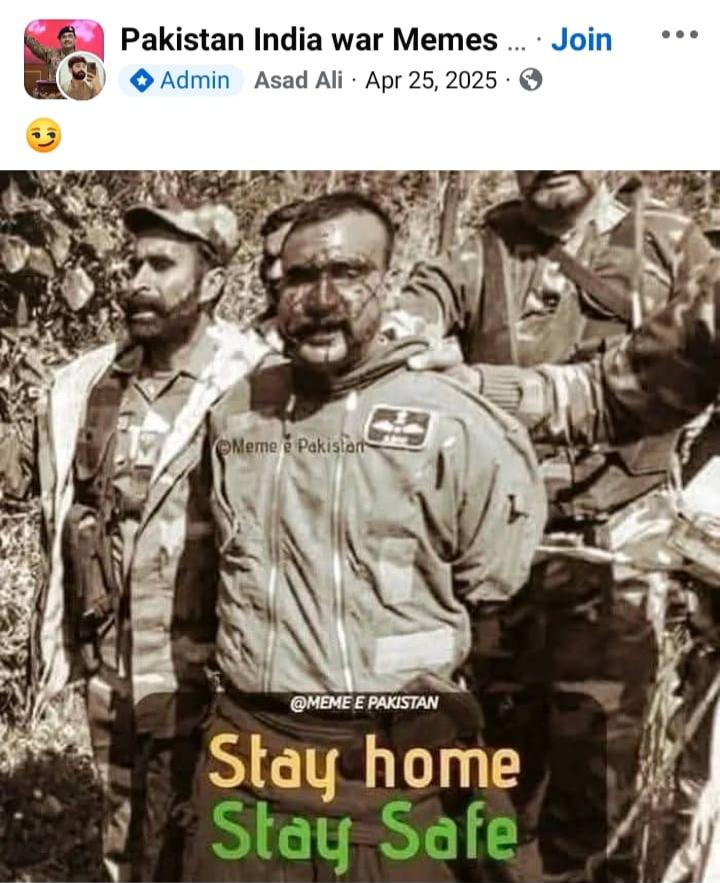
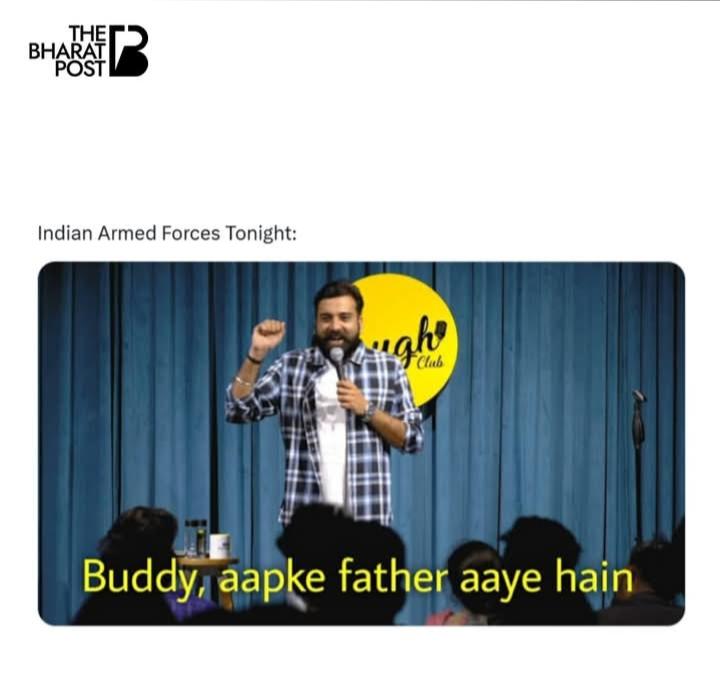
The Indian meme features a man with one hand up, in a closed fist, speaking into a microphone on a stage, with a blue curtain in the background. There are more indistinct figures of people sitting in the front, and a yellow circle with a comedy club logo in the background. The text, in bold black font above the image, reads "Indian Armed Forces Tonight", while the yellow text, at the bottom of the image, is written in Roman Hindi and English. At the top left corner of the post, there is a publication logo "The Bharat Post". The Pakistani meme includes three images of men in military uniform, with some trees and greenery in the background. The man in the middle is the Indian pilot who was captured by Pakistan in 2019 Balakot incident, with visible blood marks on his face and a flight suit with a badge on the shoulder, while the men surrounding him appear to be Pakistani soldiers holding the Indian captured pilot. There is bold yellow and green text at the bottom of the image and a small winking emoji in the top left corner of the post.
Hyper-nationalism in Indian meme is built on humour and boast. The caption is a mixed Hindi English clause, "Buddy, aapke father aaye hain", a colloquial taunt signifying that a superior force is coming to punish an inferior one; military action now becomes a comic assertion of superiority. The Pakistani meme is hyper-nationalistic with irony, based on a real historical event that of the downing of the Indian pilot in 2019. The term "Stay home Stay safe" comes from the public health warning during COVID-19 and is used sarcastically signaling that Pakistani forces have already proved their skill and they can do it again. While the Indian meme is based on a mental bravado, the Pakistani meme is based on a real result, and thus has a more understated tone of mockery, rather than boasting.
There is also a difference between the two memes when it comes to Anderson's (2006) idea of Imagined Community. It means that Indian meme relies on common knowledge of a colloquial linguistic style, whereas the Pakistani meme appeals to common knowledge of a national memory of the incident from 2019, assuming that its target audience will be able to instantly identify the man in the image and interpret the caption to refer to that specific victory instead of a generic boast. The Ideological Square (1998) that Van Dijk constructs is a combination of positive self and negative other presentation, with a different basis in the positivity. The Indian meme builds its notion of superiority on humour and while the Pakistani meme lays its claim on a fact and widely known event, the capture of the pilot, thus providing its self-presentation with a factual basis as opposed to a hypothetical one.
Indo-Pak Memes 02: Comparative Analysis
Indian meme is based on cartoons and was posted on an Indian Instagram account during the Indo-Pak 2025 conflict. Pakistani meme is also an Instagram post and shows an image of damaged Indian military aircraft from the 2025 Indo-Pakistan conflict.
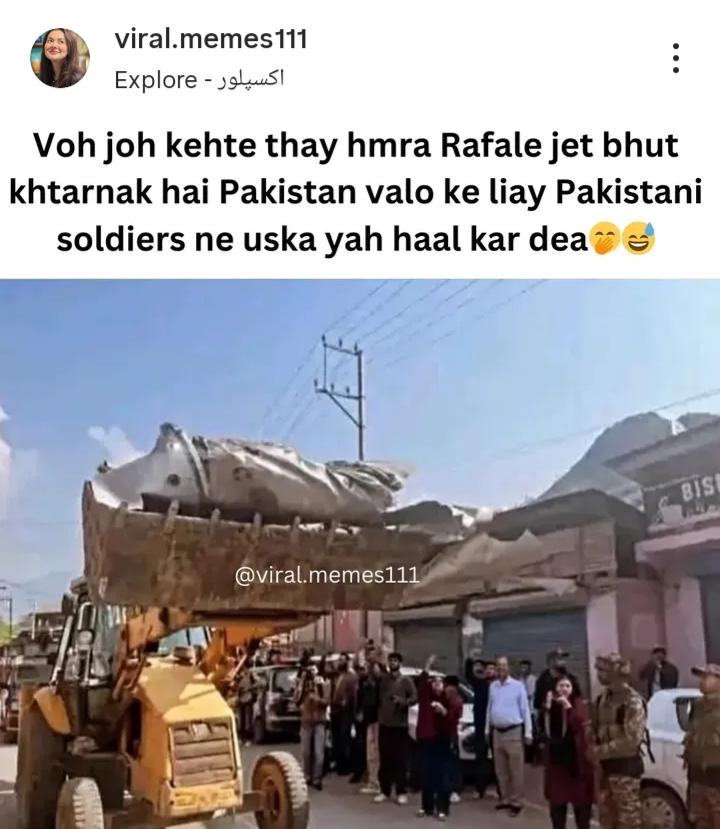
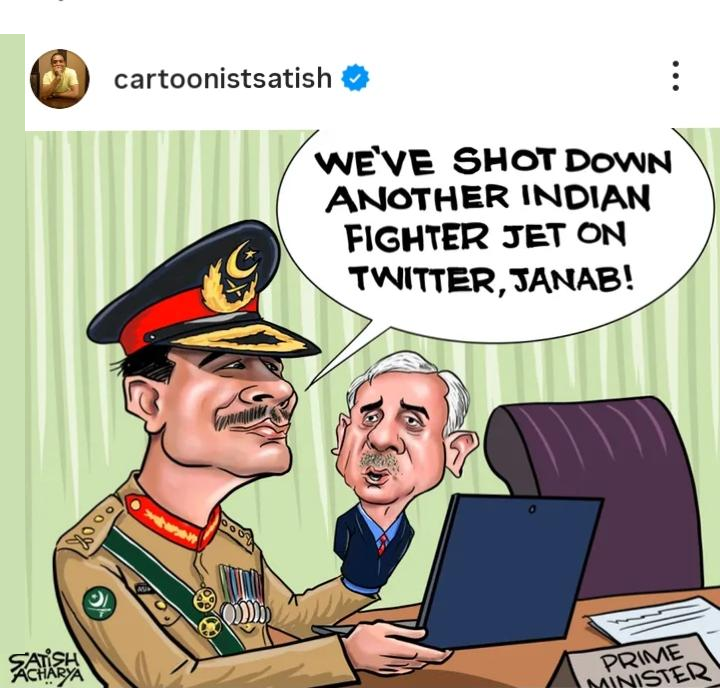
Indian meme shows a cartoon of a Pakistani army general pointing at a smaller figure, possibly labeled prime minister, with a laptop in front of him. The text in a speech bubble above the general is displayed in bold capital letters. There is a chair and a desk with a nameplate on it that reads: "Prime Minister", which form the setting of the meme as Pakistani prime minister's office. The Pakistani meme is a picture of Indian military aircraft debris on a front loader bearing, with a group of soldiers and civilians standing together on a street, some shops visible in the background. The text at the top of the image is in Roman Urdu, with laughing emojis.
In the Indian meme, the Pakistani army chief is shown as telling the prime minister, "We've shot down another Indian fighter jet on Twitter Janab", which seems to be a joke on Pakistani military's credibility. The humor here is criticizing and undermining the opposition by showing their authority figures as lying and self-congratulatory. The Pakistani meme is the exact opposite, depicting bodies in shambles as evidence of an actual military accomplishment. The caption: "Voh jo kehte thay hmra Rafale jet bhut khtarnak hai Pakistan valo ke liay Pakistani soldiers ne uska yah haal kar dea", directly mocks at an earlier Indian claim about the strength of Rafale jet using the wreckage image to refute the claim.
Each meme has a distinct Imagined Communities frame. The Indian meme takes the Pakistan army for granted that its audience already has a negative sentiment towards the Pakistani military, which means it does not require the presence of the actual evidence. The Pakistani meme has the expectation that the audience will have some recollection of the original Rafale claim, giving the wreckage significance only to those with that particular national memory of the exchange. Both memes use Van Dijk's Ideological Square (1998) with the targets of positive and negative representation inverted between them. The Indian meme undermines the opposing military's credibility, mocking its claims as bogus, a negative other presentation, which is purely satirical without any evidence. Instead, the Pakistani meme strengthens its self-presentation with visual evidence, and the wreckage as a refutation of a certain Indian claim about the Rafale.
Indo-Pak Memes 03: Comparative Analysis
Indian meme is an Instagram post, shared on Indian social media account during conflict of Indo-Pak 2025. Pakistani meme is also an Instagram post shared by a Pakistani social media user during the 2025 Indo-Pak conflict.
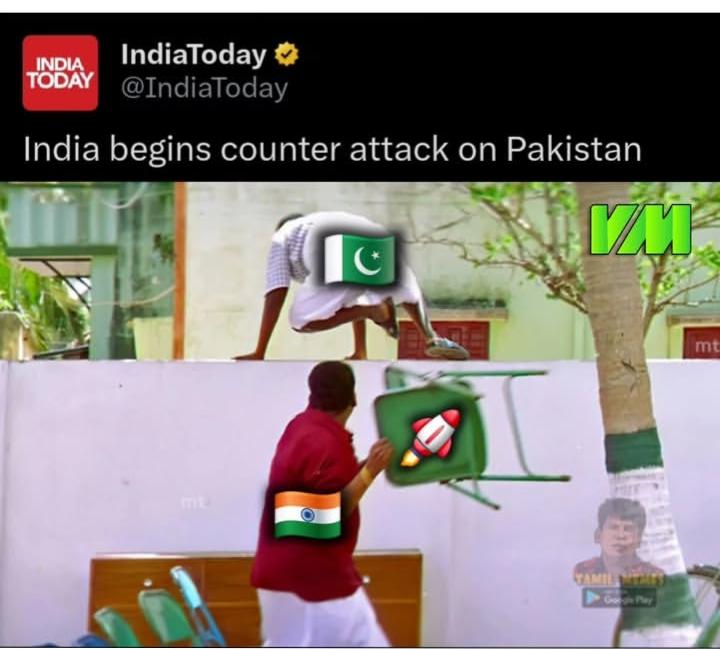
The Indian meme employs a screenshot of movie scene and the caption reads: "India begins counter attack on Pakistan". Below that, a man is bent forward over the wall in a stumbling position with an image of a small Pakistani flag on his back, while another man in a red shirt, with a graphic of an Indian flag on his arm, is lifting a green plastic chair with a rocket image on it, as if about to strike. The setting features a tree, a wall, and a residential courtyard.
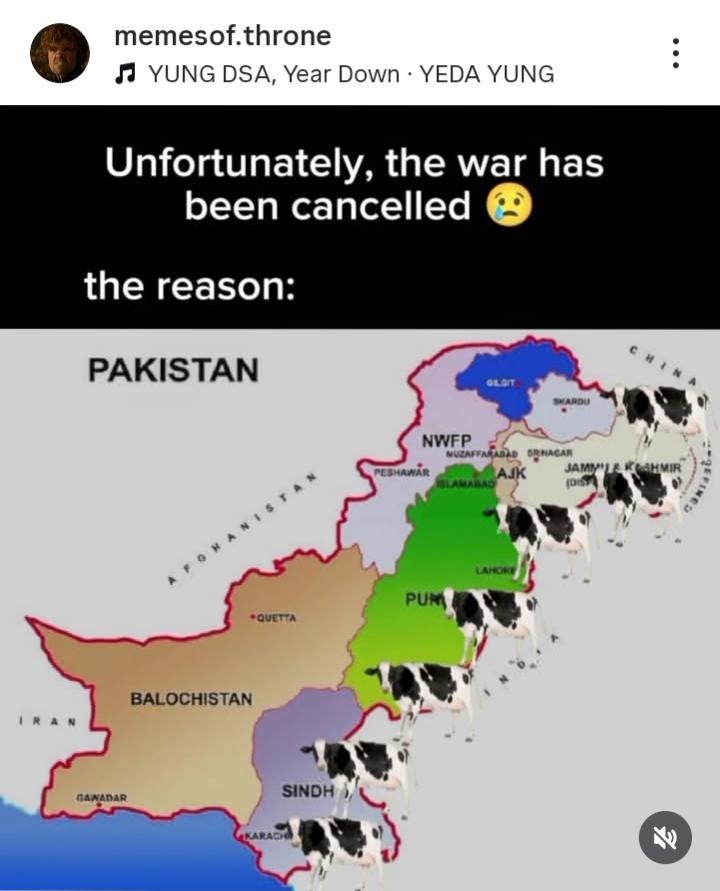
The Pakistani meme features a black banner with the text "Unfortunately, the war has been cancelled, the reason", followed by a crying emoji, below that labeled a political map of Pakistan displaying its provinces and neighbouring countries. To the east side of the map, there are a series of cows between Pakistan and the India border.
The Indian meme is a form of hyper-nationalism, using slapstick humour, by taking an image of an Indian movie and superimposing national flags, making it a fake war between the two nations. The caption, "India starts the counter attack against Pakistan", is a sensationalist headline to make a trivial confrontation into a national military narrative, with the Indian figure becoming the aggressor who has now gained the upper hand. The Pakistani meme builds hyper-nationalism by means of irony that is related to the sensitivity of religion and culture. The cow image that is lined on the border, suggests that the cow is a sacred animal in Hindu culture and that it would repulse Indian military attack. The caption, "Unfortunately, the war has been cancelled", suggests that it is a dig at the cultural and religious restrictions faced by the Indian people.
Anderson's (2006) notion of Imagined Communities can be seen here with different cultural codes, in each meme. The Indian meme relies on having a common knowledge of the borrowed viral movie image and its comedic significance in domestic pop culture, while the Pakistani meme relies on shared knowledge of Hindu religious symbolism, assuming that its target audience is able to understand the cow reference without any additional context. Both memes contain Van Dijk's (1998) Ideological Square, although with different elements of self- and other-presentation emphasized. In the Indian meme, Indian side is portrayed as active and in control, while the Pakistani side is losing momentum. The Pakistani meme constructs its case using other presentation that is negative, claiming that the opposition's actions would be limited by religious sensitivity, but not claiming to have any military might of its own.
Indo-Pak Memes 04: Comparative Analysis
Indian meme is a tweet posted by an X (Twitter) social media account of an Indian and Pakistani meme is a Facebook meme shared by Pakistani social media user during the 2025 India-Pakistan conflict. Both memes traits an AI-generated image with a caption written in English.
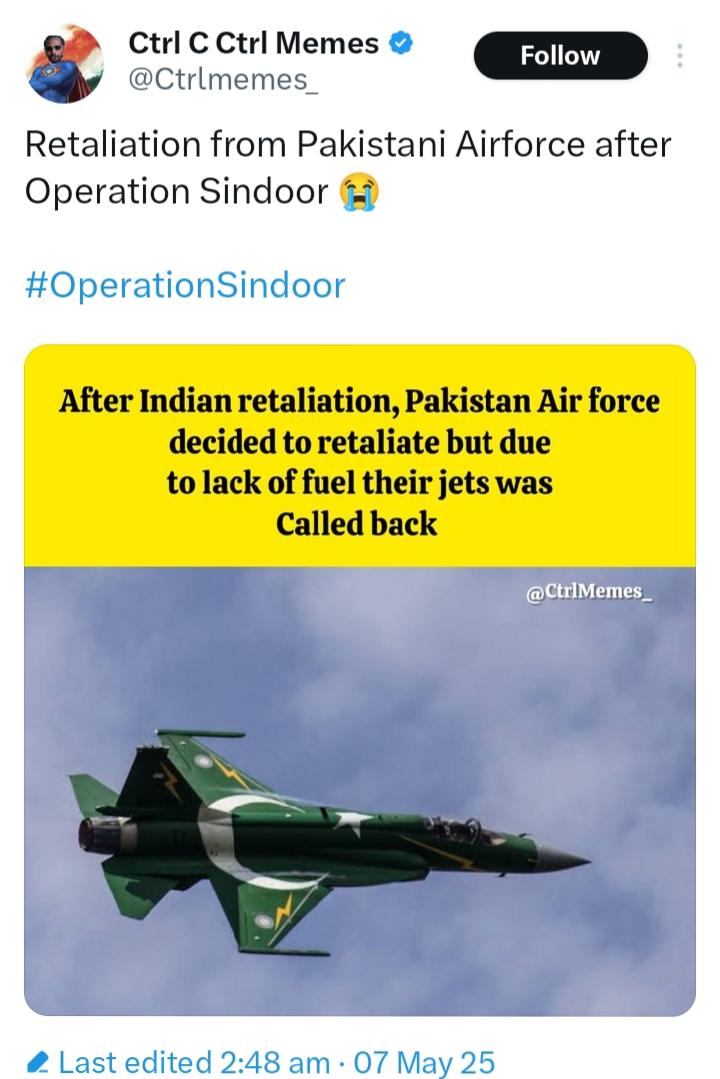
The Indian meme features a simple white background at the top, followed by black text that details the content of the meme. Under this, bold black text can be seen in bright yellow box stating that Pakistan's jets were recalled due to the shortage of fuel. The text is difficult to miss, and the yellow colour adds a mocking tone to the meme. Below, a green-painted Pakistani fighter jet with the white star and crescent can be seen flying in a plain sky with light clouds. The top text is in a mocking tone, whereas the sky in the photo is calm and cloudy.
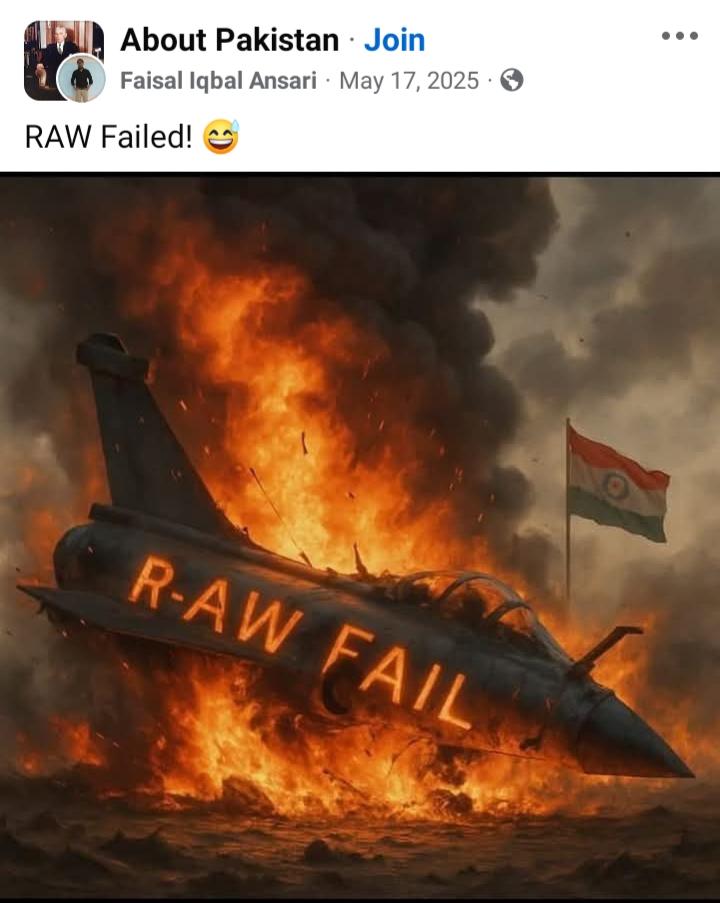
The Pakistani meme features an edited image of a fighter jet in flames, with thick black smoke billowing in the background. The predominant colours in the image are yellow and red, which are symbols of fire and destruction. The words R-AW FAIL are scrawled across the body of the jet in large, orange letters, and a teeny tiny Indian flag is displayed in front of the wreckage. The sky is smoky and the overall scene is chaotic and intense.
The motive of Indian meme is hyper-nationalism and mocking the military strength of the Pakistani army. This states that Pakistani planes ran short of fuel and were forced to return suggests that they are weak, poorly planned and poor performing. The humor here is in bringing down the military image of Pakistan in a light and sarcastic manner.
The Pakistani meme embodies hyper-nationalism with an even more aggressive and visual mockery. The meme depicts an Indian aircraft that has been burned to a crisp and outright accuses RAW, the Indian intelligence agency, of its total failure in the operation. The mockery is stronger and more powerful than the Indian meme, which is text-based.
Here, Anderson's (2006) concept of Imagined Communities is relevant as both memes connect their respective national audiences with laughter at the expense of the opposing side. The mocked shortage of fuel brings viewers on to the Indian side, and the image of a burning Indian jet brings the viewers on to the Pakistani side.
The Ideological Square (1998) of Van Dijk is also evident. The Indian meme has a positive spin on itself depicting that the Indian plans are good and Pakistan is lack of them. The Pakistani meme is projecting the self in a positive light and India is shown in a negative light, with the image of destruction and defeat. Though they rely on different visual evidence, both memes are the same in their ability to raise the in-group by humiliating the out-group.
Indo-Pak Memes 05: Comparative Analysis
Indian meme is found on an Indian X (Twitter) account and Pakistani meme is an Instagram post shared on Pakistani Instagram account, during the 2025 India-Pakistan conflict.
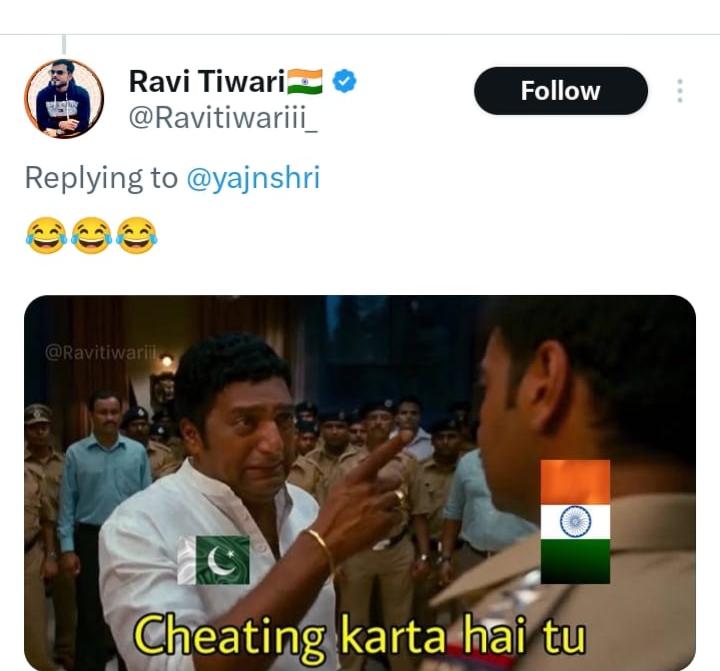
The Indian meme depicts an Indian movie "Singham" scene in which a villain, with his finger pointing at an officer (hero) in police uniform, showed as panic and surrounded by a group of uniformed police men. To connect the two figures to the two countries, small icons of Pakistan and India flags are attached to each figure, with laughing emojis placed in the top of the post. The caption is written in bold yellow letters in the bottom of the picture.
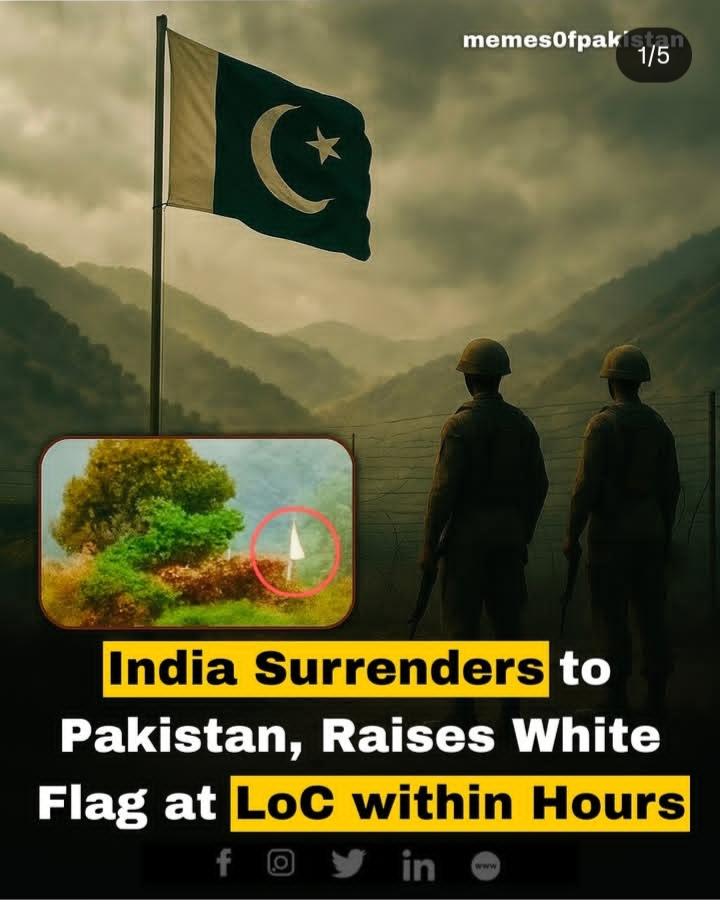
The Pakistani meme features a large Pakistani flag, set against a cloudy sky, with two soldiers standing on mountain. A small white flag with a red circle on it is visible in the insert image on the left side, close to some plants. In the lower part of the image, there is a black strip with few yellow highlighted phrases that reads: "India surrender to Pakistan, raises white flag at LoC within hours". The overall colour scheme is dark green, grey, and yellow, which creates a sense of tension and seriousness within the image, likely related to a military context.
The Indian meme builds hyper-nationalism with an appropriated cinematic drama; a dialogue from Singham is used to make an accusation against Pakistan. It takes a dramatic turn in the caption, "Cheating karta hai tu," which shows Pakistani side appear to panic through the actor's gesture and tone. The Pakistani meme creates hyper-nationalism by referencing a real event and referencing the inset photograph as evidence to make a direct claim in the text. The caption, "India Surrenders to Pakistan, Raises White Flag at LoC within Hours," suggests that the image of the white flag is a proof of the Indian surrender, and the image is zoomed and circled, giving it a visual credibility.
Anderson's (2006) Imagined Communities also functions differently across the two memes. The Indian meme is dependent on the knowledge of Bollywood movies, and the punch line and the accusation play out only for people who know the movie and the character. The Pakistani meme is based on real event reference and shared collective national memory of a specific white flag incident at the LoC.
Van Dijk's (1998) Ideological Square is present in both memes as negative other presentation, but the two have different sources of authority in order to build up the presence of the negative other. The Indian meme uses a popular film scene to convey a sense of emotion, portraying Pakistan as being panic and not based on real facts or events. The Pakistani meme, on the other hand, makes use of photographic proof and suggests that seeing white flags is an actual thing that cannot be made up and does not require dramatization to get the point across to its audience. The Pakistani meme is a positive one, saying that Pakistan has won a battle in the on-going war and India has already surrendered.
Indo-Pak Memes 06: Comparative Analysis
Indian meme is an Indian's Facebook account post and Pakistani meme is an Instagram post; posted as evidence of Pakistani claim of downing Indian aircrafts, both are related to Indo-Pak conflict 2025.
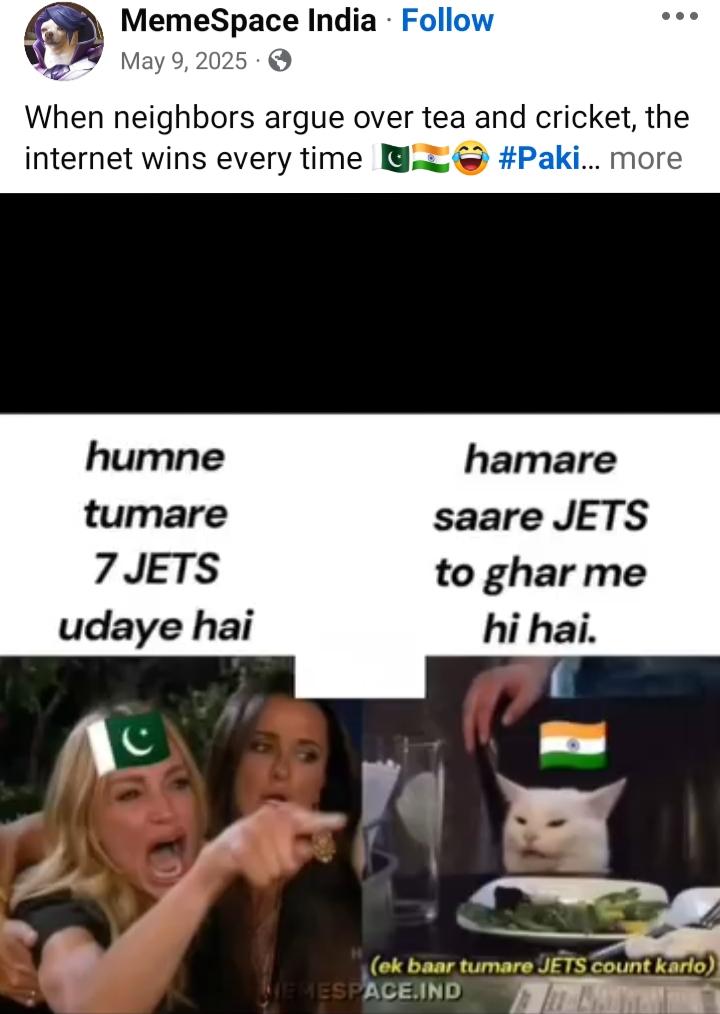
It is a well-known internet meme template used in the Indian meme. The left side has two women, one of them pointing with a green flag representing Pakistan, and shouting, along with the words that "we have shot down your 7 jets". On the right, a white cat sits at a dinner table with an Indian flag on top, with text that all of India's jets remain safely at home. The background of the picture is plain black, and the background behind the text is white, which emphasizes the characters and the flags they are wearing on their heads. The expression of the cat is calm and unconcerned while that of the shouting woman is angry, thus providing a strong contrast between the two.
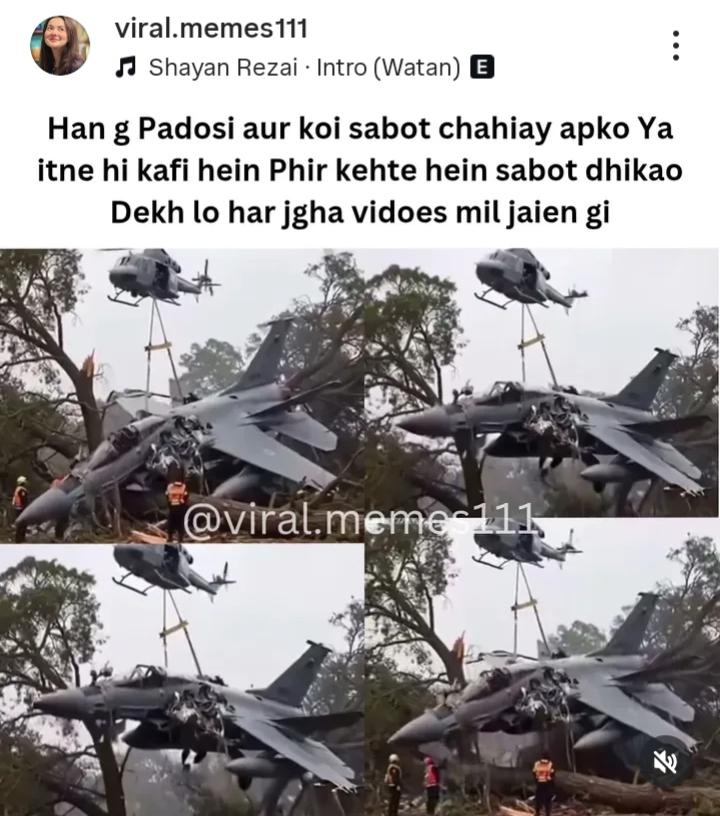
The Pakistani meme is a real photo of a crashed aircraft being hauled by a helicopter, with ground personnel on the scene standing near the wreckage amidst trees. The image is shown four times in a 2x2 grid, creating the effect of the wreckage being viewed from slightly different angles and thus appearing to be well documented. The background features natural elements such as greenery and a cloudy sky, creating a realistic and serious atmosphere. The big, bold black text at the top defies the viewer who seeks proof and declares that videos are everywhere.
The Indian meme is hyper-nationalistic and mocks. The meme portrays the shooting down of the Indian jets as loud and dramatic and that it was an untruth whereas the situation in India is completely different. Pakistani meme is also an example of hyper-nationalism, asking for validation and proof. This meme will not use humour, instead it will bolster the success narrative of Pakistan's war with the crashed jet as concrete proof, directly challenging those who doubt the validity of the same. So, the Indian meme is about having no loss; about laughing at the opposing claim; the Pakistani meme is about a claim of victory on a real, repeated photographic evidence to support its claim; about defying the accusations of exaggeration.
Two things make Anderson's (2006) concept of Imagined Communities relevant here: both memes connect their audiences through a common response; one via laughter, the other via faith in visual evidence. Indian viewers are bound together by a derisive laugh at Pakistan's falsehood and Pakistani viewers are bound together by the same wreckage image as true. In both memes, Van Dijk's (1998) Ideological Square also appears. The Indian meme is positive about itself, as it portrays itself as calm and untouched, whereas Pakistan is negative, being loud, exaggerating, and dishonest. The Pakistani meme implies that Pakistani side is good and truthful and the other (India) side is bad and doesn't accept clear facts and evidence.
Indo-Pak Memes 07: Comparative Analysis
Indian meme is a tweet about Pakistani missile, shared on an Indian X (Twitter) account during the Indo-Pak conflict 2025. Pakistani meme was shared on Pakistani Instagram account and depicts Pakistan's actions during Indo-Pak 2025 conflict.
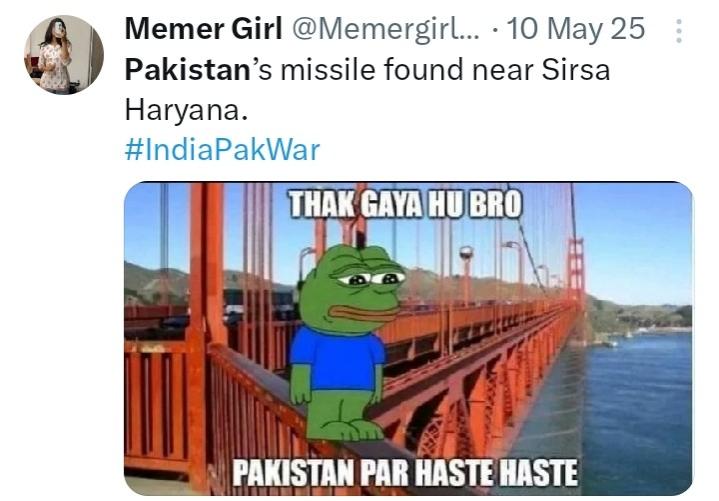
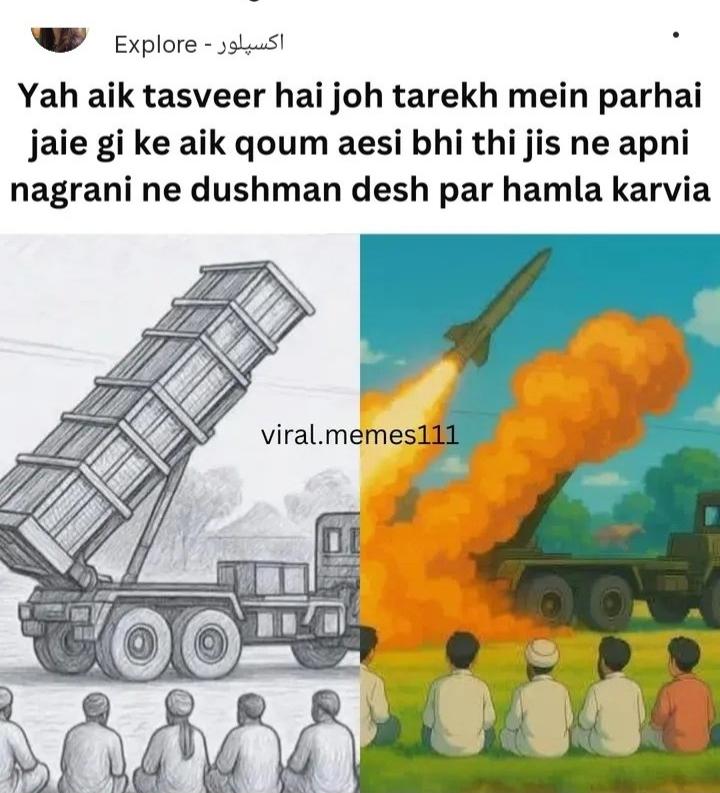
The Indian meme includes a cartoon image of "Pepe the Frog" is depicted standing on the Golden Gate Bridge, wearing a blue shirt and a tired, bored look on his face with text on top and bottom of the image. The caption reads: "Pakistan's missile found near Sirsa Haryana" and the hashtag IndiaPakWar. The Pakistani meme features an illustrated panel instead of a photo that are connected together. The left panel is drawn in grey pencil sketch style, showing a missile launcher truck with a row of men sitting with their backs to the viewer. The right side of the screen depicts the same scene, but in full color, with the same men standing and the missile now flying in bright orange smoke and flames. The bold black writing at the top is on a white background and states that: This is a picture that will be read in history, that there was a nation that under its own supervision launched an attack on the enemy country. The colour shift from grey sketch to bright colour highlights the point of action and impact.
The Indian meme builds hyper-nationalism via mockery, with the tired Pepe to poke fun at a Pakistani claim about their country's missile. The captions "Thak gaya hu bro" and "Pakistan par haste haste" indicate that to mock Pakistan has become an easy and convenient pastime, making Pakistan an easy and repeated target for ridicule. The Pakistani meme creates hyper-nationalism by directly challenging this type of assertion by making itself a documentary evidence against India and calling it "dushman desh" (enemy country). The caption reads:"Yah aik tasveer hai joh tarekh mein parhai jaie gi ke aik qoum aesi bhi thi jis ne apni nagrani me dushman desh par hamla karvaya," which implies that the missile launch was a historic event for the nation to strike its enemy under its watch and is meant to serve as a factual rebuttal to India's mocking narrative.
Anderson's (2006) Imagined Communities functions on different cultural registers. Indian meme relies on creating the sense of dismissiveness by contextualizing the situation as part of an internet meme culture, which requires the collective recognition of the Pepe character. In Pakistani meme, the notion of historical consciousness and the idea of it being a moment that belongs to the nation's history, appealing to an idea of collective prides that goes beyond a fleeting moment of internet humor. Van Dijk's (1998) Ideological Square is present in both memes; each side builds up a negative other presentation in a different way. The Indian meme is, again, aimed at deriding Pakistan that is, making its actions seem so predictable that they are not worth taking seriously. The Pakistani meme counters this by asserting factual military action, presenting the missile launch as historical evidence meant to be remembered, directly countering the mockery embedded in the Indian meme's claim.
Findings and Discussion
The comparative multimodal critical discourse analysis of Indian and Pakistani memes revealed clear patterns of how national pride is created using digital humour in Pakistani and Indian social media memes during the Indo-Pak 2025 conflict. On both sides visual material is used to substantiate claims, but with the same objective: to make the self-nation look strong, the other nation weak, or foolish.
Pakistani memes frequently rely on documentary evidence such as photographs of captured personnel, missile launches, and wreckage to ground their claims of superiority in factual or historical events. This strategy lends the memes a tone of restrained confidence, since the visual proof itself carries the argument rather than requiring exaggerated language. Captions accompanying these images often use irony, repurposing familiar phrases such as public health slogans or invoking cultural and religious references, including allusions to the sacred status of cows in Hindu tradition, to mock the opposing side without resorting to direct insult. Indian memes, by contrast, lean more heavily on humor drawn from popular culture, including standup comedy footage, Bollywood film scenes, and viral photographs repurposed with national symbols. Where Pakistani memes tend to assert dominance through evidence, Indian memes tend to assert it through comedic framing, though both strategies serve the same underlying function of elevating the self while diminishing the other. Images, captions, symbols, cultural and religious references work together consistently to reinforce hyper-nationalist ideology in both sets of memes, though the specific resources each side draws upon differ. Pakistani memes often use symbols like the national flag and military uniforms and also repeat real events that people already know about, like the 2019 Indian pilot capture. Indian memes instead use characters and formats from internet, like Pepe the Frog, and take old viral photos and give them a new national meaning by adding flags and new captions.
Since Pakistani memes depend on audiences already remembering events like the Indian pilot capture, while Indian memes depend on audiences already recognizing internet humor and cultural references, here Anderson's (2006) idea of Imagined Community explains why these strategies succeed. Each shared understanding pulling its own national audience closer together while pushing the other further away. These patterns also confirm that Van Dijk's (1998) Ideological Square, positive self-presentation paired with negative other presentation, operates as the shared foundation beneath both sets of memes, regardless of whether the strategy used is evidence based or humor based.
Conclusion
In a nutshell, this study analyzed memes from the Indo-Pak 2025 conflict, focusing on their linguistic and visual strategies that create positive self-representations and negative portrayals of the other, reinforcing hyper-nationalist ideologies. Pakistani memes are characterized by documentary evidence and historical grounding, conveying a tone of restrained confidence, while Indian memes utilize humor from popular culture for comedic dominance. Despite the differing styles, both adhere to van Dijk's (1998) Ideological Square of positive self-presentation and negative other-presentation, illustrating a shared structural logic of hyper-nationalist discourse. The findings validate Anderson's (2006) Imagined Community concept, emphasizing how memes require shared cultural knowledge, thereby enhancing national identity through entertaining content in digital culture, during the Indo-Pak conflict 2025.
References
- Anderson, B. (2006). Imagined communities: Reflections on the origin and spread of nationalism (Rev. ed.). Verso.
- Arshad, Z., Mehmood, M. S., & Ahmad, A. (2025). Exploring the educational memes in recent Indo-Pak War. Dialogue Social Science Review, 3(8), 87–102.
- Bashir, B., & Shahid, D. M. (2025). Framing conflict: A review of media representation during the 2025 Pakistan-India War. ACADEMIA International Journal for Social Sciences, 4(2), 1279–1285. https://doi.org/10.63056/ACAD.004.02.0254
- Dawkins, R. (1976). The selfish gene. Oxford University Press.
- Feyyaz, M., & Bari, S. H. (2024). A critical analysis of India and Pakistan’s terrorism discourse in the context of geopolitics and imperialism. Critical Studies on Terrorism, 17(3), 606–630.
- Ghilzai, S. A. (2025). Digital battlegrounds: Multimodal humor and ideological framing in memes of the 2025 Pakistan-India conflict. ACADEMIA International Journal for Social Sciences, 4(2), 2345–2368. https://doi.org/10.63056/ACAD.004.03.0689
- Jan, S. M., Latif, F., & Ali, S. (2023). Peace and conflict depiction in newspapers blog contents: A comparative analysis of Pak-India relations since 2019-2020. Global Digital & Print Media Review, 6(1), 107–123. https://doi.org/10.31703/gdpmr.2023(vi-i).09
- Khan, M. U. (2016). Hyper nationalism vs human rights. Human Rights Review. https://humanrightsreviewpakistan.wordpress.com/hyper-nationalism-v-human-rights/
- Kress, G., & van Leeuwen, T. (2001). Multimodal discourse: The modes and media of contemporary communication. Arnold.
- Maryam, R., Ullah, M., & Ashraf, K. (2025). Militarised narratives and retaliatory rhetoric: A comparative CDA of the 2025 India-Pakistan war. Journal of Arts and Linguistics Studies, 3(2), 3433–3457.
- Rai, N., & Thapa, B. (2015). A study on purposive sampling method in research. Kathmandu School of Law, 5(1), 8–15.
- Schofield, V. (2000). Kashmir in conflict: India, Pakistan and the unfinished war. I.B. Tauris.
- Van Dijk, T. A. (1998). Ideology: A multidisciplinary approach. Sage Publications.
Cite this article
-
APA : Asghar, S., & Rabbani, M. (2026). Hyper-Nationalism in Indo-Pak Social Media Memes on Indo-Pak Conflict 2025: A Comparative Multimodal Critical Discourse Analysis. Global Political Review, XI(I), 120-132. https://doi.org/10.31703/gpr.2026(XI-I).10
-
CHICAGO : Asghar, Sawera, and Munazzah Rabbani. 2026. "Hyper-Nationalism in Indo-Pak Social Media Memes on Indo-Pak Conflict 2025: A Comparative Multimodal Critical Discourse Analysis." Global Political Review, XI (I): 120-132 doi: 10.31703/gpr.2026(XI-I).10
-
HARVARD : ASGHAR, S. & RABBANI, M. 2026. Hyper-Nationalism in Indo-Pak Social Media Memes on Indo-Pak Conflict 2025: A Comparative Multimodal Critical Discourse Analysis. Global Political Review, XI, 120-132.
-
MHRA : Asghar, Sawera, and Munazzah Rabbani. 2026. "Hyper-Nationalism in Indo-Pak Social Media Memes on Indo-Pak Conflict 2025: A Comparative Multimodal Critical Discourse Analysis." Global Political Review, XI: 120-132
-
MLA : Asghar, Sawera, and Munazzah Rabbani. "Hyper-Nationalism in Indo-Pak Social Media Memes on Indo-Pak Conflict 2025: A Comparative Multimodal Critical Discourse Analysis." Global Political Review, XI.I (2026): 120-132 Print.
-
OXFORD : Asghar, Sawera and Rabbani, Munazzah (2026), "Hyper-Nationalism in Indo-Pak Social Media Memes on Indo-Pak Conflict 2025: A Comparative Multimodal Critical Discourse Analysis", Global Political Review, XI (I), 120-132
-
TURABIAN : Asghar, Sawera, and Munazzah Rabbani. "Hyper-Nationalism in Indo-Pak Social Media Memes on Indo-Pak Conflict 2025: A Comparative Multimodal Critical Discourse Analysis." Global Political Review XI, no. I (2026): 120-132. https://doi.org/10.31703/gpr.2026(XI-I).10