- To explore the most frequently used nouns, pronouns, and modal verbs
- To examine how language is exploited for the construction of political ideologies and identities.
- What are the most commonly used nouns, pronouns, and modal verbs in the election manifestos of Pakistani political parties?
- How does the use of nouns, pronouns, and modal verbs help the political parties in the construction of ideologies and identities?
- Chilton, P. (2004). Analyzing Political Discourse: Theory and Practice. London Routledge
- Fairclough, N. (1998). Political discourse in the media: an analytical framework. In A. Bell & P.
- Garrett. (Eds.). Approaches to media discourse. Oxford: Blackwell Publishers.
- Fasold, R. (1990). Sociolinguistics of language. Oxford: Blackwell.
- Hote, M., & Lemmens, M. (2009). Reframing treason: metaphors of change and progress in new Labour discourse. Cognitextes, 3:280-330.
- MacDonald, M. (2001). The policy space of party manifestos in estimating the policy space of political actors. UK: Routledge.
- Van Dijk, T. A. (2001). Ideological discourse: A multidisciplinary introduction. International Journal of Linguistics, 1(4).
- Van Dijk, T. A. (1998). Ideology: An Interdisciplinary Approach, London, Sage.
- Van Dijk, T. A. (2001). Critical Discourse analysis. In Handbook of Discourse Analysis.
Abstrict
The goal of this study is to use corpus-based methods for the critical discourse analysis of election manifestos. Five election manifestos from five political parties of Pakistan namely PPP, PMLN, PTI, JUI, and JI were used in the corpus compilation. These five Pakistani political parties are selected based on the popularity of these political parties in Pakistan. The election manifestos of the political parties were combined into a complete text file. The corpus was analyzed using ANTCONC 3.5.8 software. Van Dijk’s Socio-Cognitive Model (1998) was used as a theoretical framework for this study. The results of the study indicate that the political parties use language to exert cognitive control on the public. The use of nouns, pronouns, and modal verbs allows these political parties to transform people's ideologies, create identities, and gain control over them.
Keywords
Election Manifestos, Political Parties, Corpus-Based, Pakistan
Introduction
The present study investigates the use of language in the corpora of election manifestos of Pakistani Political Parties with an aim to examine how language components are exploited by these political parties to create a positive self-image and gain cognitive control on the masses. Since language plays a central role in political communication, there is an essential connection between politics and linguistics. Therefore, language plays a pivotal role in the manifestation of a power struggle in achieving power and control (Chilton, 2004). Political leaders often practice rhetoric to exert power, and this power can be observed both in the spoken text during the political parties' elections campaign and in written statements in the manifestos of the political parties. Discourse analysis is the point at which language meets ideology. Critical discourse analyses can help in investigating the ideological dimensions of political discourse, such as election manifestos, political speeches, etc. Politicians can maintain and prolong their power through persuasive and compelling use of language, which helps them gain the support of the public in elections. Critical discourse analysis helps understand the concealed meanings of the political discourse and exposes the hidden political ideologies and identities in the text.
The present study explores the role of nouns, pronouns, and modal verbs in the language of the election manifestos (2013 and 2018) of five Pakistani political parties: PPP, PMLN, PTI, JUI, JI. The corpus-assisted critical discourse analysis of these parts of speech (nouns, pronouns, and modal verbs) helps us examine how these language units help in the construction of political ideologies and identities.
Statement of Problem
The connection between the language of the political parties and their beliefs can be observed in their political narratives which serve as a valuable tool to influence individual or group activities by shaping people's perceptions. The public census in voting for a political party is based on the ideology of the party and is reflected in the election manifesto of the party. It is important to explore the linguistic devices employed in the discourse that help the political parties win the support of their voters. According to the best of our knowledge, this link between language and politics has not received much attention in Pakistan. The current study attempts to contribute to the existing literature by exploring the role of language in the manifestos of Pakistani political parties.
Research Objectives
Research Questions
Delimitation
Due to time constraints, the current study examines only the nouns, pronouns, and modal verbs found in the election manifestoes of five political parties. These parties are the Pakistani Peoples’ party (PPP), Muslim League Nawaz (PML-N), Pakistan Teheerk-e-Insaaf (PTI), Jamiat-e-Ulmaiay Islaam (JUI), and Jamaat-e-Islami (JI).
Literature Review
Ideologies involve the communication of ideas, and therefore, language plays a central role in the construction and maintenance of discrimination and oppression. Language may never be impartial because it is a conduit between our social worlds (Van Dijk, 1998). Politicians reconstruct realities based on professional and personal ideologies. Powerful messages from politicians carry powerful coded meanings and messages. These coded meanings and messages reinforce individual beliefs, behaviors, and collective ideologies that have an unavoidable impact on the formation of public policies and organizational practices. These coded meanings and messages are evaluated through critical discourse analysis to find out how speech patterns work in a specific structure and how speech patterns are used and exploited in society (Fasold, 1990).
Critical discourse analysis is an interdisciplinary approach that studies the textual structures concerning society. Critical discourse analysis also examines the relationship between the text and the other texts. Most kinds of CDAs ask questions about how specific discourse structures are deployed in the reproduction of social dominance, whether they are part of conversations or news reports, or other genres and contexts (Van Dijk, 1998, p.131). The main task of critical discourse analysis is to trace the relationship between discourse and social power. An important and most related concept of ideology is that of power (Van Dijk, 1998). Social power refers to the control of a group that could be an organization or an institution. Our utterances carry hidden knowledge and meanings hidden in the words we use. In fact, discourse analysis is an analysis of the ideologies packed in language. Mind control and manipulation are two key concepts in discourse analysis that are achieved through political discourse (Van Dijk, 2000). Controlling the mind of the audience is a major trick for politicians to recreate their hegemony. Manipulation and mind control are related to cognition, mental action, or the process of learning. The word exploitation can be replaced by the word 'hidden meaning' in critical discourse analysis. The meanings of the words are transformed by the speaker who creates a discourse with a purpose in mind.
Manifestos are a form of political discourse that outlines the policies advocated by political parties. Election manifestos have certain ideological objectives and goals (MacDonald, 2001). The voter may have an estimate of the position of the party on ethnic, cultural, and racial grounds. Manifestos make it easier for the voter to base his decision on the party's position on the issues and vision that the party holds. Manifesto text can be seen as a persuasive text that aims to win the support of the voters. The corpus-assisted critical discourse analysis methodology is a recent field that exploits the use of computer and critical discourse analysis models in the analysis of large text corpora. Some studies have already used a corpus-based approach for the analysis of political discourse (see Hote and Lemmens, 2009).
Research Methodology
The study used a corpus-based methodology for the critical discourse analysis of election manifestos. Five election manifestos (2013 and 2018 elections) were taken from the five political parties of Pakistan, i.e. PPP, PMLN, PTI, JUI, JI. These five manifestos of the political parties were combined into a complete text file. The corpus was analyzed using ANTCONC 3.5.8 software (Anthony, 2006). The data was tagged for parts of speech using parts-of-speech tagger (POS Tagger). The frequency of the nouns, pronouns, and modal verbs was calculated using the keyword list function of AntConc. Concordance lines were examined to extract nouns, pronouns, and modal verbs used in their linguistic context. After that, the concordance lines for each part of the speech were interpreted and explained.
Theoretical Framework
Van Dijk’s Socio-Cognitive Model (1998) was used as a theoretical framework for this study. The main task of critical discourse analysis is to trace the relationship between discourse and social power. An important and most related concept of ideology is that of power (Van Dijk, 1998). Social power refers to the control of a group that could be an organization or an institution. Our utterances carry hidden knowledge and meanings hidden in the words we use. In fact, discourse analysis is an analysis of the ideologies packed in language. Mind control and manipulation are two key concepts in discourse analysis that are achieved through political discourse (Van Dijk, 2000). Controlling the mind of the audience is a major trick for politicians to recreate their hegemony. Manipulation and mind control are related to cognition, mental action, or the process of learning.
Data Analysis
In the first phase of the data analysis, the frequencies of nouns, pronouns, and modal verbs are calculated and presented in the form of tables and graphs. In the second phase, nouns, pronouns, and modal verbs were explained in their linguistic context.
Nouns
Table 1. Frequency of Frequently used Nouns
| width="106"> PPP width="106">PMLN width="106">PTI width="106">JUI width="106">JI | > Health width="106">92 width="106">17 width="106">17 width="106">6 width="106">7 | > Policy width="106">127 width="106">44 width="106">65 width="106">2 width="106">9 | > Party width="106">91 width="106">11 width="106">2 width="106">1 width="106">3 | > Corruption width="106">4 width="106">2 width="106">3 width="106">3 width="106">6 | > Youth width="106">23 width="106">16 width="106">17 width="106">5 width="106">10 |
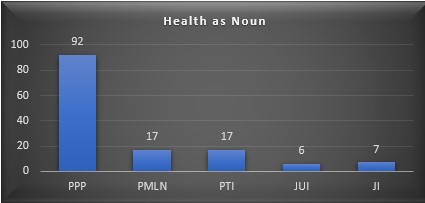
Nouns are extensively used in all forms of communication. The nouns given above were found in the political manifestos of the political parties. The use of nouns helps the political parties to promote their agenda. There is a lot of variation across the parties in the use of the above-given nouns. The higher use of a noun underscores its importance. In election manifestos, political parties mention several plans and policies that, according to them, can uplift the masses. If we look at the table above and the graphs below, we find that the noun ‘health’ is the most frequently used in PPP’s manifesto with a frequency of 92 times.
4 in sectors such as education, infrastructure, health arid water supply improves the quality of PML-N-Manifesto-Booklet-min.txt
6 welfare centers across Punjab at family health clinics Create Hospital Management and PML-N-Manifesto-Booklet-min.txt
10 2023, we will have a system that would ensure health for all, and increased health PML-N-Manifesto-Booklet-min.txt
14 (PKLI) in Lahore. The PM National Health Program has opened access for the abject poor PML-N-Manifesto-Booklet-min.txt
16 poverty under the Prime Minister National Health Program Granted Rs. 2,000 per month to more PML-N-Manifesto-Booklet-min.txt
3 provide assisted births along with family health and planning information to women. We will manifesto-PTI-converted.txt
4 the budget estimate will be earmarked for the health sector. The healthcare budget will be increased JI_2013_English (1).txt
5 to reveal the sources of their information. Health services will be provided free to all JI_2013_English (1).txt
The concordance lines given above show the linguistic context of the noun “health”. We can see that PPP explains the various aspects of the health sector and how the party plans to improve the health sector. The frequency of the noun ‘health’ is 7 times in PMLN’s manifesto. PMLN shows national health programs’ and promises health facilities for all. The frequency of the noun ‘health’ is 17 times in PTI’s manifesto. PTI promises reforms in health and claims that everybody will have equal access to health facilities. The frequency of health is 6 in JUI’s manifesto. The frequency of the noun ‘health’ is 7 in JI’s manifesto.
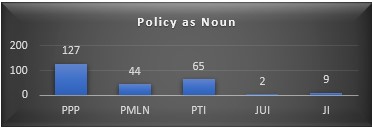
The noun “policy” has been used in the manifestos to refer to the wrong policies of other political parties which could cause damage to the various sectors. The noun policy was also used to refer to the policies of the parties that the party has planned if it comes into power. The frequency of noun ‘policy’ in PPP’s manifestoes is 127 whereas in PMLN’s it is 44. The frequency of “policy” in PTI’s manifesto is 65. The frequencies of “policy” are 2 and 9 in manifestoes of JUI and JI, respectively. The noun “policy” is given below with its linguistic context in the form of concordance lines.
“There is visible dynamism in Pakistan foreign policy. The country is seen as a liberal, PML-N-Manifesto-Booklet-min.txt.”
“policies more effectively in terms of successful foreign policy operationalization. One: A more robust, proactive” manifesto-PTI-converted.txt
2 “a reap real benefits. 14). Foreign policy: A) Foreign policy will be framed keeping in view” JUI-F_2013_English-converted.txt
1 “occupation will be the cornerstone of our foreign policy. We hold in the highest esteem” JI_2013_English (1).txt
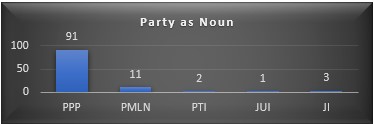
The noun ‘party’ is used to refer to the unique policies of the party. The noun “party” has been used 91, 11, 2,1 and 3 in the manifestoes of PPP, PLMN, PTI, JUI and JI, respectively.
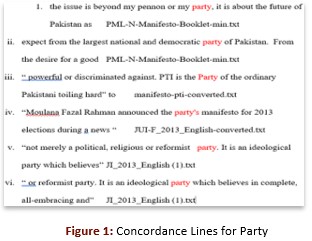
We can see from the concordance lines that the noun ‘party’ is used with the verb ‘believes’ in PPP’s manifesto to draw the attention of the people. PMLN uses the noun ‘party’ to show that it is a democratic party. PTI shows that it is the party of ordinary people. JI describes that it is a religious and ideological party.
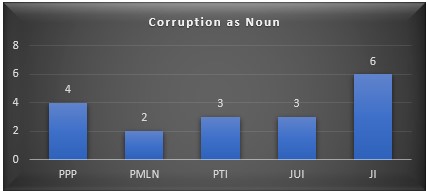
The frequency of the noun ‘corruption’ is 4, 2, 3, 3, and 6 in the manifestoes of PPP, PMLN, PTI, JUI, and JI, respectively.
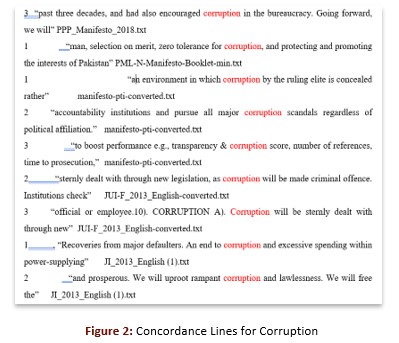
We can see in the concordance lines that PPP promises to eradicate corruption and believes that the previous governments did not pay attention to the corrupt practices prevalent in various departments. PTI claims to hold the political elite accountable for their corrupt practices. JUI describes that corruption will be dealt with strictly. JI shows in its manifesto that JI will uproot widespread corruption and lawlessness, and there will be corruption free country.
The noun “youth” can also be found in the manifestoes of these political parties. The employment and education of youth seem to be a very important part of all political parties manifestoes. The frequency of the noun ‘youth’ is 23, 16, 17, 5, and 10 in the manifestoes of PPP, PMLN, PTI, JUI, and JI, respectively.
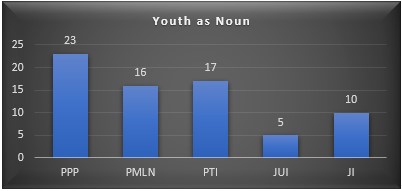
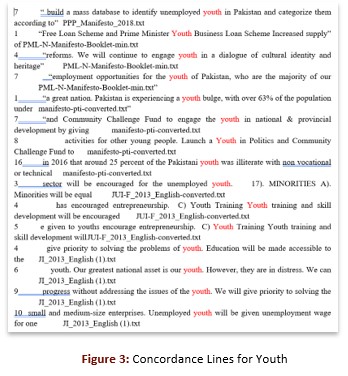
It can be gathered from the concordance lines that PPP propagates itself as the strongest youth brand, as its president is the youngest among all the other parties. PPP also explains that young people will have access to education, and PPP will build a mass database to identify unemployed youth in Pakistan. PMLN will introduce a free loan scheme and a Youth Business Loan Scheme for unemployed young people. The PMLN will also provide employment opportunities for young people. In its manifesto, PTI shows that 63% of Pakistan's population is young. PTI will introduce youth in politics and local government. PTI will also establish vocational programs for illiterate young Pakistanis. In its manifesto, PTI shows that entrepreneurship and training programs for young people will be encouraged. JI shows its priority for youth to solve youth problems, because youth is our greatest national asset, and education will be accessible to young people. All these political parties have certain common characteristics with regard to the empowerment of young people in Pakistan. Young people are of great importance in the country, and the future of the country depends on the youth of the country.
Pronouns
Table 2. Frequency of Frequently used Pronouns
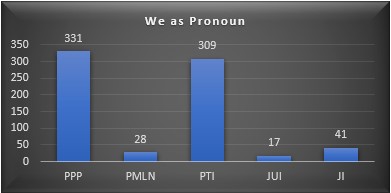
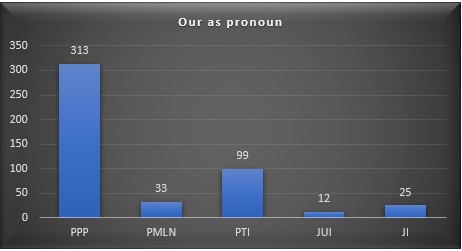
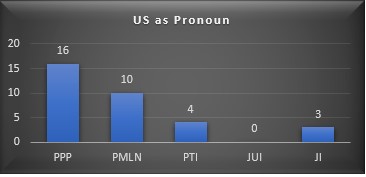
| width="106"> PPP width="106">PMLN width="106">PTI width="106">JUI width="106">JI | > We width="106">331 width="106">28 width="106">309 width="106">17 width="106">41 | > Our width="106">313 width="106">33 width="106">99 width="106">12 width="106">25 | > Us width="106">16 width="106">10 width="106">4 width="106">0 width="106">3 | |
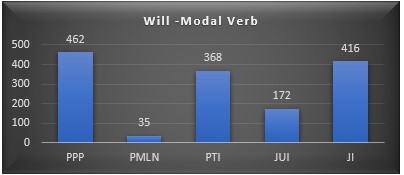
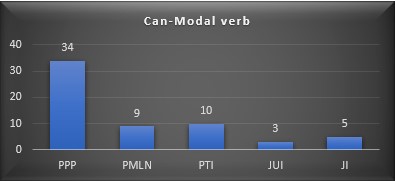
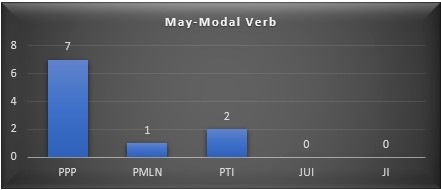
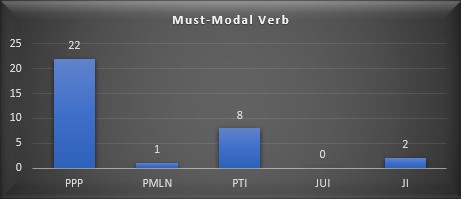
| width="88"> PPP width="91">PMLN width="88">PTI width="88">JUI width="88">JI | > Will width="88">462 width="91">35 width="88">368 width="88">172 width="88">416 | > Can width="88">34 width="91">9 width="88">10 width="88">3 width="88">5 | > May width="88">7 width="91">1 width="88">2 width="88">0 width="88">0 | > Must width="88">22 width="91">1 width="88">8 width="88">0 width="88">2 |